
Custom Jewelry Wholesale for Retail Chains
A chain buys a collection the way it buys any other line item: one decision, repeated across doors. That makes the per-design minimum the first arithmetic in the plan, not the last — 50 pieces of 925 sterling silver per design is also 50 pieces to spread over a store list, and a forty-door rollout at two units each needs 80 pieces before the design is viable at all. Get that sum wrong and the collection ships with either dead stock or empty shelves.

Key takeaways
- Multiply doors by units per door before choosing designs: 40 stores at 2 units needs 80 pieces, comfortably above a 50-piece silver minimum.
- Each design and metal carries its own MOQ, so a five-design chain range is five runs even when it ships as one delivery.
- Sampling at 25–30 days plus production at 3–4 weeks gives 48–60 days from CAD brief to dispatch.
- Barcode labels and backing cards belong in the first purchase order, because store receiving will reject a carton without them.
One design, many doors: the allocation problem
Chain retail turns a simple order into a distribution exercise. The collection has to look the same in every store, which means one design, one plating tone and one card per SKU, repeated at a volume that covers the full estate. A design that sells in a flagship and sits in a mall unit is not a design problem; it is an allocation problem created before the order was placed.
The fix is to work backwards from the planogram. Decide units per door, multiply by doors, then check the result against the minimum for the metal. Two units across 40 doors is 80 pieces per design. Four units across 25 doors is 100. Both clear the 50-piece silver threshold, but they produce very different replenishment profiles — and replenishment is where chain programs usually break.
A custom jewelry wholesale order for a chain is also a set of runs rather than one line, because the MOQ attaches to each design and each metal. Three designs in silver and one in brass is four runs sharing a delivery date. That structure is normal; the planning mistake is treating the four as a single volume and discovering at the purchase order stage that each one has to stand on its own.
Phasing is the other lever. A 120-door estate does not have to take all 120 pieces at once; it can take 60 for launch doors and 60 for the second wave, provided both waves sit inside one approved production plan. The constraint is not storage but approval: a second wave that reopens the sample costs another 25–30 days, while a second wave drawn from the same approved run costs only the freight decision. Split the delivery, not the specification.
| Doors | Units per door | Pieces per design | Position against the minimum |
|---|---|---|---|
| 20 | 2 | 40 | Short by 10; the run must be topped up to 50 |
| 20 | 3 | 60 | Clears 50 with 10 spare for damages |
| 40 | 2 | 80 | Clears 50 with 30 spare for replacements |
| 60 | 2 | 120 | One run covers the estate with no split shipment |
| 120 | 1 | 120 | One unit per door; no buffer for swaps |
Keeping batches matched across a chain
Consistency is a manufacturing question before it is a merchandising one. The collection is only uniform if every unit comes from the same mould, the same plating specification and the same approved sample. That is why 100% final inspection matters for a chain more than for a single boutique: a colour shift between two production batches shows up as two different products on adjacent shelves.
The controls that support this are process controls, not promises. ISO 9001:2015 covers quality management across all production stages. BSCI covers labour and social audit. REACH compliance confirms the material is free of lead, cadmium and nickel, and the plating carries its own statement of compliance with REACH and CA Prop 65. For a waterproof line, the stainless steel jewelry manufacturer route pairs 316L with PVD plating, which keeps the finish stable across daily wear.
Packing is the second half of consistency. A carton that arrives at a distribution centre without a scannable barcode label, or with the wrong backing card, is a delay regardless of how good the plating is. Metallic logo tags, foil-stamped gift boxes, velvet or microfiber pouches, display backing cards and barcode labels are all specified per SKU, so the packaging list should be finalised alongside the CAD drawings rather than after the pieces are finished. Chain programs that treat packaging as an afterthought usually pay for it in a second shipment.
CAD sets the launch date
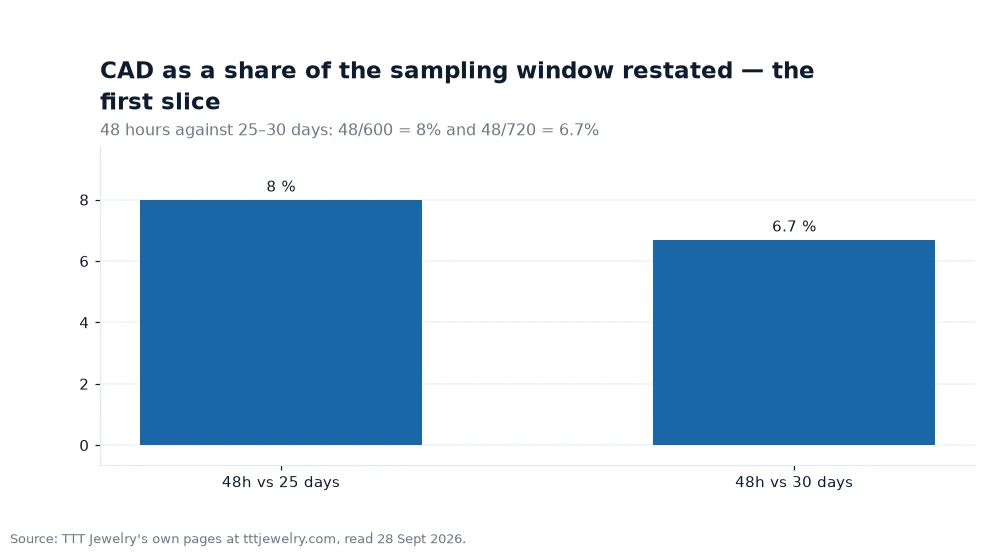
Chain buyers work to a launch calendar, and the calendar is mostly fixed work. CAD modelling lands in under 48 hours, which is 2 days against a sampling window of 25–30 days — between 6.7% and 8% of the sample stage. Sampling then consumes the rest, and production follows at 3–4 weeks. From brief to dispatch, the path is 48–60 days, or 7–9 weeks.
Because CAD is such a small slice of the window, it is the wrong place to save time. A launch date is far more exposed to a rejected sample, which adds a full 25–30 days, than to a two-day modelling stage. Buyers who need the packaging, material and finish options in one view can explore more of the wholesale matrix before locking a planogram, then brief all designs at once so sampling runs in parallel.
Worked example
A 40-door chain plans three silver designs at two units per door. Each design needs 40 × 2 = 80 pieces, which clears the 50-piece minimum by 30 units per design. The order totals 3 × 80 = 240 pieces, split into three runs with three CAD files and three samples. Sampling runs 25–30 days in parallel, production 21–28 days, so the calendar is 2 + 25 to 30 + 21 to 28 = 48–60 days. Now consider the first replenishment: one replacement unit per door is 40 pieces, which is 10 short of the 50-piece minimum. The chain either tops the reorder up to 50 and holds the extra 10 as buffer stock, or waits and combines two designs into a single 80-piece replenishment. Planning that number before launch is what keeps the second order from becoming an exception.
Frequently asked questions
Can one design cover every store in a chain?
Yes, provided the total run clears the per-design minimum for the metal. One design at two units across 40 doors is 80 pieces, which is above the 50-piece silver threshold. The same design across 20 doors at two units is 40 pieces, so the run has to be topped up to 50.
How should barcode labels be handled for a chain order?
They belong in the packaging specification from the first purchase order. Barcode labelling is one of the listed packaging options, alongside metallic logo tags, foil-stamped boxes, pouches and display backing cards. Supplying store codes before production starts avoids a relabelling step at the warehouse.
What if one store needs a size the run does not include?
The size range is part of the specification, not a separate order. A size that is not in the approved sample should be added before production, because sizing after casting means new masters. Building the size curve into the initial 50 or 80 pieces is cheaper than a follow-up run.
Writing the chain brief
A chain brief that works is short and numeric: doors, units per door, size curve, metal, plating tone, hallmark, packaging and delivery date. Add the store list with barcode codes and the document is complete enough to quote and schedule without a second round of questions. TTT Jewelry sets out the factory-direct model, the six-step OEM/ODM flow and the 100% NDA terms that chain buyers usually ask about first. Give a supplier that brief and the reply is a schedule rather than a conversation.
Source note: figures come from the manufacturer's own website (tttjewelry.com), read 28 Sept 2026.[1]