
EDP or EDT for a Travel Retail First Order: Cost and Concentration
The concentration decision is usually made in the brief and felt in the cost sheet, the testing plan and the shelf-life claim at the same time. For a first travel retail order, the honest way to choose is to work the arithmetic in public: pick a retail price, work back to a cost ceiling, and then see which concentration fits inside it with room for the pack. Choosing the format first and negotiating the price afterwards is how first orders end up under-margined or re-briefed.
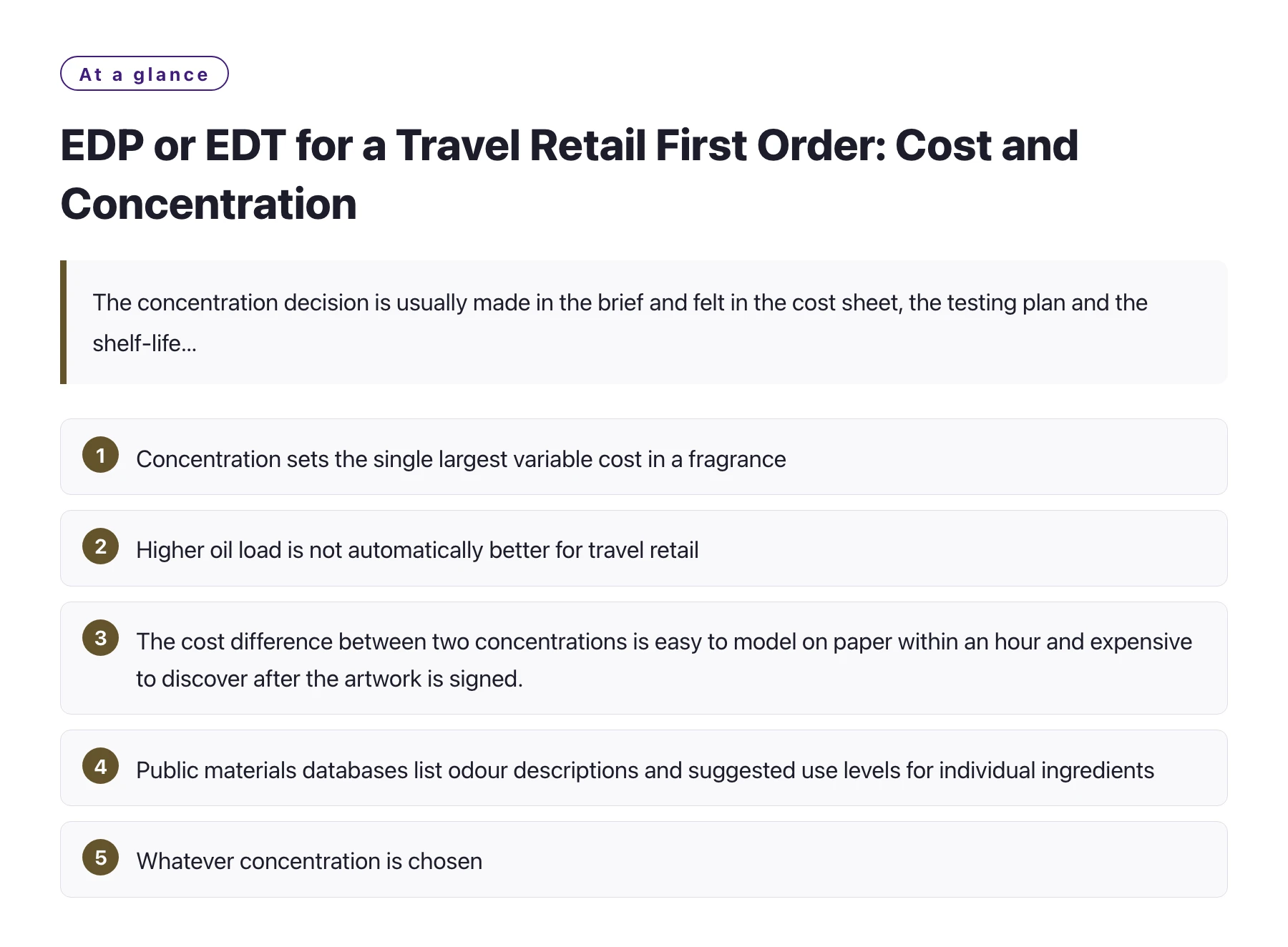
Key takeawaysConcentration sets the single largest variable cost in a fragrance, because the compound is the most expensive input and the fill volume multiplies it. · Higher oil load is not automatically better for travel retail, because it interacts with the pack, the shelf-life claim and the material restrictions that apply to some ingredients [1]. · The cost difference between two concentrations is easy to model on paper within an hour and expensive to discover after the artwork is signed. · Public materials databases list odour descriptions and suggested use levels for individual ingredients, which is a practical way to sanity-check a brief before it is priced [2]. · Whatever concentration is chosen, the delivered product should match the approved sample, so the format decision and the sample approval belong in the same conversation.
Imagine a first order of 3,000 units for a duty-free counter, a target retail price that the channel has already agreed, and a brand margin that has already been promised to a board. Those three numbers define the cost ceiling. The concentration question is really a question about how much of that ceiling the liquid is allowed to take.
This walkthrough follows the order in which the numbers actually bind. It is written for someone preparing a first order rather than for someone reforming an existing line, which is why it starts with the shelf and ends with the specification.
Step one: work backwards from the counter price
Start with the pick-up price, not the brand's own price list
Travel retail pricing has its own logic. The price the traveller sees is set against a domestic reference, and the operator usually takes a share that is larger than a domestic retailer's. Before the concentration conversation makes any sense, the brand needs the price it will actually receive per unit, after the operator's share and any listing cost.
That number, minus the target gross margin, is the landed cost ceiling. Everything else in the order has to fit inside it, which is why the concentration decision cannot be made in isolation from the pack.
Split the cost ceiling into three buckets
The practical split for a first order is liquid, pack, and everything else. The liquid bucket is dominated by the compound and the fill volume. The pack bucket covers the vessel, closure, pump, decoration, carton and any insert. The third bucket is freight, duty, documentation, testing and the cost of the sample rounds.
A useful discipline is to write the three buckets as percentages before any quote arrives. Once the quotes come in, the buckets show which assumption was wrong, and that is far more informative than a total.
Step two: understand what concentration actually buys
Concentration is a ratio between fragrance compound and the rest of the formula, and it is normally described in ranges rather than fixed points, because different houses and markets draw the lines differently. What matters for the first order is not the label on the bottle but the behaviour it implies, and a fuller treatment of EDP vs EDT concentration is worth reading before the brief is finalised, because the differences the labels hide are exactly the ones that appear on a cost sheet.
A higher oil load typically gives more presence and longer perceived wear, which is what a gift or travel purchase tends to be judged on. It also raises the liquid cost proportionally, can change the colour of the juice, and can change how the product behaves in a small spray pack where the ratio of surface area to volume is high. A lower load reduces cost but shortens the impression the traveller forms on the first spray, which is the only impression a duty-free counter gets to make.
Formats, and what each one changes downstream
| Format | Oil load commonly quoted | What it changes for a first travel retail order |
|---|---|---|
| Eau de cologne | Low single digits | Cheapest liquid cost, but the shortest wear, so it suits a large-format refresh rather than a gift |
| Eau de toilette | Roughly 5 to 15 per cent | The lower-cost route into a gift line, with less presence on a paper strip than an EDP |
| Eau de parfum | Roughly 15 to 20 per cent | The default for gift and travel assortments, at a liquid cost that has to be modelled before the pack is fixed |
| Extrait or parfum | Higher than an EDP | Strongest presence and the highest liquid cost, usually paired with a smaller fill to protect the price point |
| Body or hair mist | Low, often with a different carrier | Opens a lower price tier in the same set, with its own compatibility questions inside the box |
The ranges are industry conventions rather than fixed rules, so always confirm the actual figure in the specification rather than on the label.
Step three: model the delta before you brief
The arithmetic
The cost of the liquid is the compound cost per kilogram multiplied by the oil load and the fill volume, plus the cost of the alcohol, water and any other carrier. If the compound costs a known figure per kilogram, the difference between a 10 per cent load and an 18 per cent load on a 50 ml fill is a calculation you can do on one line, and it should be done before the brief leaves the building.
Do it for two fill sizes as well. A 30 ml EDP and a 50 ml EDT can land at similar liquid costs while behaving very differently on a shelf, and that comparison is the one that usually resolves the argument.
The part that is not arithmetic
Two non-cost effects travel with the concentration choice. The first is regulation: some materials carry use restrictions in a given product category, so a higher load is not always technically available even when the budget allows it, and the published standards are the reference to check [1]. The second is performance in the specific pack, where viscosity, colour and atomisation can all move.
Both effects are reasons to test a shortlist of two concentrations rather than one. A first order that tests two loads on the same brief, in the same pack, produces data that supports the final decision, and it usually costs one extra sample round rather than a redesign.
Step four: put concentration into the specification
Once the format is chosen, write it into the specification as a figure with a tolerance, together with the compound reference and the fill volume. A specification that says eau de parfum without a percentage and a tolerance leaves the delivered product exposed to drift, because a change in compound or a slightly different fill can move perceived strength without anyone intending it.
The specification is also the input to the stability programme. Different oil loads behave differently in the same bottle, so if the load changes after the compatibility work was done, the result no longer covers the product. Sequence the decisions so the concentration is frozen before testing starts, not after.
Finally, remember that a labelled format is a claim about the product. The buyer at the counter, and the customer, will read the label as a description of what is inside, so the figure in the specification and the figure on the label should be the same number, with the same tolerance.
Where the pack itself is bespoke, the concentration conversation happens in parallel with a packaging brief, and it is worth reading how a bespoke fragrance development and production scope is structured so the two tracks are scheduled together rather than one after the other.
And because the concentration choice is the largest single line in the liquid bucket, it is also the first thing to check when two quotations look inexplicably far apart. A comparison guide that explains where a perfume quote can hide costs is a quick way to see whether the gap is concentration, fill volume or something outside the bottle entirely.
Freeze three numbers before the first sample round: fill volume, oil load with a tolerance, and the landed cost ceiling. Each of them changes what the other two can be, and none of them can be fixed after tooling starts.
Sources
- IFRA Standards Library (International Fragrance Association) —— The IFRA Standards Library lists the restrictions the fragrance industry applies to individual fragrance ingredients, based on safety assessments; it is the reference point for compliant fragrance formulation.
- The Good Scents Company —— A reference database of aroma materials with odour descriptions, CAS numbers and typical usage information.
Frequently asked questions
Is an EDP always more expensive than an EDT?
For the same fill volume and the same compound, yes, because the oil load is higher. Across different fills and compounds the comparison can reverse, so compare the specification rather than the format name.
Can a travel retail gift set mix an EDP and a body mist?
Yes, and it is common, but each item is a separate compatibility and stability question inside one box, so budget the testing for both.
Does a higher concentration need a different bottle?
Not automatically, but it can change colour and flow enough to matter in a small spray pack, so confirm with a compatibility check on the exact vessel and pump.
How do we explain the concentration choice to a retailer?
Describe what the traveller experiences, the fill volume and the price tier. Retailers buy a price point and a story, and the oil percentage is supporting detail rather than the argument.
What is the biggest mistake on a first order?
Choosing the pack and the price first, then discovering that the intended concentration does not fit the remaining budget. Model the liquid before committing to tooling.
Book a 30-minute Reliability Diagnostic.
A senior principal engineer walks your asset-care baseline, scopes one measurable win, and tells you whether a full engagement is justified.